

High purity aluminum plays an important role in some of the most demanding thin-film applications in modern research and advanced manufacturing. From Josephson junctions and superconducting qubits to SRF cavities, SQUIDs, kinetic inductance detectors, and RF components, aluminum is widely used because of its stable oxide, strong cryogenic performance, and compatibility with established thin-film deposition processes.
For researchers and engineers working in quantum computing, superconducting electronics, and advanced RF systems, the purity of the aluminum source material can directly affect film quality, interface cleanliness, device performance, and repeatability.
What Are Superconducting Thin Films?
Superconducting thin films are extremely thin layers of material that exhibit superconducting behavior below a critical temperature. These films are commonly used in quantum devices, cryogenic sensors, resonators, and high-performance microwave and RF components.
In these applications, film quality matters. Surface contamination, metallic impurities, interface defects, and inconsistent microstructure can all contribute to performance losses. For this reason, researchers often pay close attention not only to deposition conditions, but also to the purity and consistency of the aluminum source material used in the process.
Why Aluminum Is Used in Superconducting Applications
Aluminum is one of the most widely used materials in superconducting thin-film research, especially in Josephson junctions and superconducting qubits.
One major reason is aluminum's native oxide, Al₂O₃. When aluminum is oxidized under controlled conditions, it forms a thin and stable tunnel barrier. This makes aluminum especially useful for Josephson junction fabrication, where two superconducting electrodes are separated by an insulating oxide layer.
Aluminum is also compatible with well-established fabrication methods such as Dolan bridge and Manhattan-style shadow evaporation. These processes are widely used in superconducting qubit research because they allow researchers to create small, controlled junctions with predictable tunneling behavior.
Because aluminum has a low critical temperature, it is well suited for devices operating in dilution refrigerators and other cryogenic environments. In these settings, impurity control becomes especially important.
Why Aluminum Purity Matters
In superconducting and quantum applications, small differences in purity can have a large impact. Impurities in the aluminum source material can affect the deposited film, the metal-substrate interface, and the resulting device performance.
Common concerns include:
● Two-level system defects: Defects at interfaces or within oxide layers can contribute to energy loss in superconducting qubits and resonators.
● Quasiparticle generation: Certain impurities can disrupt superconducting behavior and contribute to quasiparticle poisoning, which may reduce device performance.
● Lower residual resistivity ratio: Metallic impurities can scatter electrons and reduce the residual resistivity ratio (RRR), which is an important consideration in many cryogenic and superconducting applications.
● Magnetic contamination: Trace magnetic impurities such as iron can be especially problematic in quantum devices, SQUIDs, and other sensitive superconducting systems.
For these reasons, researchers often choose 5N, 6N, or 6N5 aluminum when working on applications where coherence, low loss, and repeatability are critical.
Recommended Aluminum Purity by Application
The right aluminum purity depends on the specific application, device architecture, and process requirements.
Josephson Junctions and Superconducting Qubits
Josephson junctions and transmon qubits are among the most demanding applications for high purity aluminum. These devices require extremely clean films, controlled oxide formation, and low interface loss. For these applications, researchers often specify 6N aluminum or 6N5 aluminum source material, especially when working on advanced superconducting qubit fabrication.
Superconducting RF Cavities and Resonators
Superconducting RF cavities and resonators require materials with strong cryogenic performance and low surface resistance. In these applications, high purity aluminum may be used in certain resonator structures, substrates, or research configurations. Depending on the system requirements, 5N to 6N aluminum is commonly considered for superconducting RF and cryogenic research applications.
SQUIDs and Quantum Sensors
SQUIDs, or superconducting quantum interference devices, are highly sensitive magnetic field sensors. Because SQUIDs are designed to detect extremely small magnetic signals, impurity control is especially important. For SQUIDs, kinetic inductance detectors, and other superconducting sensor applications, researchers often prefer 5N minimum, with 6N aluminum used when higher purity is required.
Kinetic Inductance Detectors and Cryogenic Detectors
Kinetic inductance detectors, transition edge sensors, and related cryogenic detector technologies rely on clean superconducting films and low defect density. For these applications, both film uniformity and source material purity can affect performance. Depending on the device design, 5N to 6N aluminum may be suitable.
Research and Exploratory Thin-Film Deposition
For early-stage research, process development, or exploratory deposition work, researchers may begin with 4N or 5N aluminum before moving to higher purity levels as the process becomes more refined. For applications where aluminum purity is not yet the limiting factor, 4N aluminum may be sufficient. For more demanding thin-film, quantum, or cryogenic applications, 5N, 6N, or 6N5 aluminum may provide better performance and consistency.
E-Beam and Thermal Evaporation for Superconducting Aluminum Films
High purity aluminum is commonly deposited using e-beam evaporation or thermal evaporation, depending on the process and equipment.
For superconducting qubit fabrication and Josephson junction work, e-beam evaporation is widely used. This process allows controlled deposition of aluminum films and is often used with double-angle shadow evaporation techniques.
In these processes, the shape and consistency of the aluminum source material matter. Pellets, slugs, and starting sources with consistent geometry can help support stable melting behavior and repeatable deposition conditions.
For sensitive superconducting applications, chamber cleanliness and base pressure are also critical. Even high purity source material can underperform if the deposition environment introduces oxygen, nitrogen, water vapor, or other contaminants into the film.
High Purity Aluminum Forms Used in Thin-Film Deposition
High purity aluminum is available in several forms depending on the deposition system, application, and purity requirements. High Purity Aluminum supplies 4N, 5N, 6N, and 6N5 aluminum materials for researchers, engineers, universities, laboratories, and advanced manufacturers working in thin-film deposition, quantum devices, superconducting research, and RF applications.
Common product forms include:
-
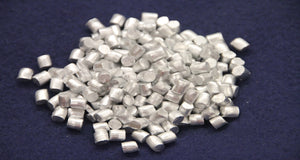
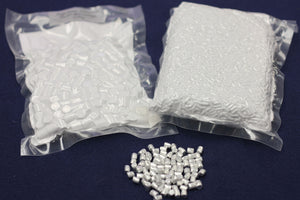
Aluminum pellets and slugs — commonly used for e-beam evaporation and thermal evaporation; convenient for loading into crucibles, boats, and pocket sources
-
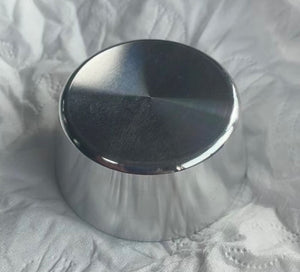
Aluminum starting sources— larger source pieces used for thin-film deposition, especially where longer runs or larger source volumes are needed
-
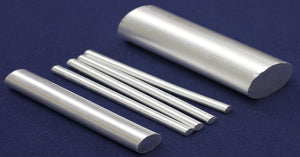
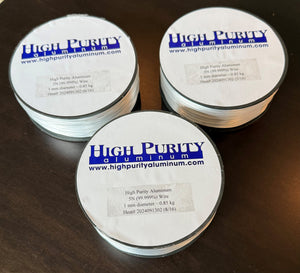
Aluminum rod, and wire — used in custom deposition setups and specialized research applications
-
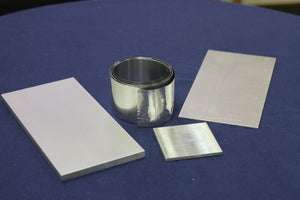
Aluminum foil, sheet, and plate— used for research, substrates, shielding, custom fabrication, and advanced manufacturing applications
-
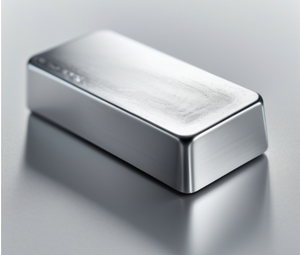
Aluminum blocks and custom forms — available for specialized requirements, machining, or custom fabrication
-
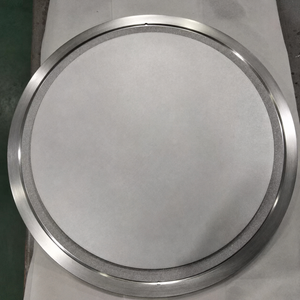
Aluminum sputtering targets — available by request for PVD thin-film deposition applications
The correct form depends on the system design, deposition method, desired film thickness, purity level, and documentation requirements. HPA can help researchers and engineers select the appropriate aluminum form, purity grade, and size for their process.
Choosing the Right Aluminum Purity
When selecting aluminum for superconducting thin films or quantum research, the most important questions are:
● What device or application is the material being used for?
● Is the aluminum being used as a deposited film, substrate, source material, or custom component?
● What purity level is required: 4N, 5N, 6N, or 6N5?
● Are specific impurity limits required for iron, copper, manganese, or other metallic contaminants?
● Is GDMS documentation needed?
● What form is required for the deposition system?
For general research, 4N or 5N aluminum may be appropriate. For demanding superconducting devices, Josephson junctions, qubits, SQUIDs, and low-loss resonators, 6N or 6N5 aluminum may be the better choice.
Contact High Purity Aluminum
If you are working on superconducting thin films, Josephson junctions, quantum computing, SRF research, SQUIDs, kinetic inductance detectors, or advanced RF applications, High Purity Aluminum can help you select the right purity and product form for your process.
Contact us to discuss your aluminum purity requirements, available inventory, GDMS documentation, Certificates of Analysis, and custom sizing options.
→ Browse High Purity Aluminum Evaporation Pellets and Starting Sources